asaxon
Well-known member
- Joined
- Nov 30, 2010
- Messages
- 1,139
- Reaction score
- 163
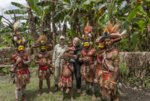
BJ, his wife MA, The Admiral and I had recently come back from Papua New Guinea Highlands where the people are totally hog-centric. A bride price could be 100 hogs or more. Is there such a thing as a “hogaholic”? They did assure us that they have given up eating tourists as they had found it is economically better to keep them alive though they were a vague about whose skulls were hanging about (Picture 1 & 2). All the pig talk got us hankering for pork and as it had been nearly two years since we last hunted hogs in California (http://www.jesseshunting.com/showth...-than-Squirrel-or-Oak-Tree?highlight=Father's), BJ and I decided it was time to go.
We arrived in King City at 4:30 am, grabbed breakfast at Denny’s, then headed east down Lone Pine canyon with Tom Willoughby to a property Tom had recently gotten the hunting lease for. The good news was that it had been several years since anyone had hunted there; hopefully the hogs would not be too skittish. The bad news was as we drove, there was increasingly thick fog. When we got to the property, we were in pea soup; no way were we going to get any hogs unless we ran them over by mistake. (Picture 3). There is actually a hog on that hillside right in the middle of that picture – if you enlarge it you can see a hazy black shape above the tall grass stalk in the middle. As we headed for the high ground to get above the fog, we passed by one big boar who ambled off into the gray haze. Once above the fog, it was like looking at the ocean with islands of land sticking out (Picture 4). Cool looking but not the best for spot and stalk hunting.
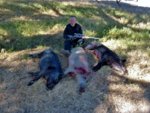
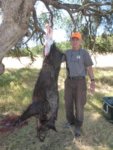
We finally dropped into a small valley that was clear and a nice hog was feeding on the far side. As we watched, it disappeared into a ravine. Bad choice for the hog as the wind was in our face, i.e. it would not smell us nor could it now see us. A lone hog is usually a boar so Tom and BJ headed out to stalk this fella (Picture 5) as a lone hog is usually a boar. I have strict orders from “The Admiral” not to bring home any boars – at least not four legged ones. After about a quarter of an hour, I hear “Boom” - Tikka T3 30-06 pushing a 150 gr. Hornady GMX bullet. About 2 minutes later another Boom. Sure enough, the first shot had dropped a nice boar but as he was still alive; they took no chance but put another round in his neck before getting too close. After collecting/gutting this fella at the truck (Picture 6), we headed up high again to get some visibility. Once there, BJ has one of those lovely senior moments: “Where are my bino straps?” After an unsuccessful search in the truck and a bit of “language”, we start glassing from a ridge top. As we are in the sun, BJ takes off his coat and lo and behold, he is wearing the bino straps. (Picture 7). Sound familiar?
Just above the dense fog, two hillside over (about ½ mile) we finally do spot a hog. Or is it two? It is very hard to tell given the distance, tall grass and fog. Half an hour in later, we have worked our way over to that hillside and there is a trail, “road” that runs along the side of it. As we walked slowly down this path, the fog was drifting in and out. Turning a corner, we saw a couple of black shapes 200 yards away in the 3-foot + tall wild oats. We can see them as they are above the fog but the grass obscures their lower body so it is hard to tell their gender. Below is simply opaque – no vis. The wind was favorable so we press on a bit and then, momentarily, the fog moves away and we can see down the very steep hillside. There on a bench of flat land some 150-200 yards below us is a whole passel of pigs. However, the fog closes in again and all is gray. Bugger! (Picture 8). We stood there for 10 minutes getting glimpses of the hogs trying to determine who was a potential “shooter”, a non-nursing sow, i.e. a so-called “dry sow”. The two biggest sows were nursing (“wet”) so they were got a free pass. There were a couple of gorgeous almost orange with black polka dots hogs but they were saved by being too small. Then all of a sudden, right in front of us and more than 75 yards away, a good sized “blonde” hog stands up out of the tall grass on the hillside. Poof, she just “appeared”. However, we can’t tell if it is a sow or a boar, too much damn grass. This hog looks right at us a couple of times when the fog lifts so we stay motionless. Finally, after for several minutes of looking at teeth, the facial structure, etc., Tom decides it is a sow and says, “Shoot it”. I line up the cross hairs on the back of the head and BAM, a 30-06 168 gr. Barnes vortex goes down range. The blonde hog collapses. Her front splay out and she proceeds to slide down to the bottom of the hill looking just like she was riding a Luge. A remarkable performance. We decided she must have been of German ancestry as the Germans are clearly the best at Luge. Picture 9, taken via telephoto lens later; shows the hog = the blonde/gray lump to BJ’s left (your right) and just inside the green line is the “path” in the grass that this hog made while making it’s Luge run. You cannot tell from the picture but that is looking way down a very steep hillside.


We arrived in King City at 4:30 am, grabbed breakfast at Denny’s, then headed east down Lone Pine canyon with Tom Willoughby to a property Tom had recently gotten the hunting lease for. The good news was that it had been several years since anyone had hunted there; hopefully the hogs would not be too skittish. The bad news was as we drove, there was increasingly thick fog. When we got to the property, we were in pea soup; no way were we going to get any hogs unless we ran them over by mistake. (Picture 3). There is actually a hog on that hillside right in the middle of that picture – if you enlarge it you can see a hazy black shape above the tall grass stalk in the middle. As we headed for the high ground to get above the fog, we passed by one big boar who ambled off into the gray haze. Once above the fog, it was like looking at the ocean with islands of land sticking out (Picture 4). Cool looking but not the best for spot and stalk hunting.
We finally dropped into a small valley that was clear and a nice hog was feeding on the far side. As we watched, it disappeared into a ravine. Bad choice for the hog as the wind was in our face, i.e. it would not smell us nor could it now see us. A lone hog is usually a boar so Tom and BJ headed out to stalk this fella (Picture 5) as a lone hog is usually a boar. I have strict orders from “The Admiral” not to bring home any boars – at least not four legged ones. After about a quarter of an hour, I hear “Boom” - Tikka T3 30-06 pushing a 150 gr. Hornady GMX bullet. About 2 minutes later another Boom. Sure enough, the first shot had dropped a nice boar but as he was still alive; they took no chance but put another round in his neck before getting too close. After collecting/gutting this fella at the truck (Picture 6), we headed up high again to get some visibility. Once there, BJ has one of those lovely senior moments: “Where are my bino straps?” After an unsuccessful search in the truck and a bit of “language”, we start glassing from a ridge top. As we are in the sun, BJ takes off his coat and lo and behold, he is wearing the bino straps. (Picture 7). Sound familiar?
Just above the dense fog, two hillside over (about ½ mile) we finally do spot a hog. Or is it two? It is very hard to tell given the distance, tall grass and fog. Half an hour in later, we have worked our way over to that hillside and there is a trail, “road” that runs along the side of it. As we walked slowly down this path, the fog was drifting in and out. Turning a corner, we saw a couple of black shapes 200 yards away in the 3-foot + tall wild oats. We can see them as they are above the fog but the grass obscures their lower body so it is hard to tell their gender. Below is simply opaque – no vis. The wind was favorable so we press on a bit and then, momentarily, the fog moves away and we can see down the very steep hillside. There on a bench of flat land some 150-200 yards below us is a whole passel of pigs. However, the fog closes in again and all is gray. Bugger! (Picture 8). We stood there for 10 minutes getting glimpses of the hogs trying to determine who was a potential “shooter”, a non-nursing sow, i.e. a so-called “dry sow”. The two biggest sows were nursing (“wet”) so they were got a free pass. There were a couple of gorgeous almost orange with black polka dots hogs but they were saved by being too small. Then all of a sudden, right in front of us and more than 75 yards away, a good sized “blonde” hog stands up out of the tall grass on the hillside. Poof, she just “appeared”. However, we can’t tell if it is a sow or a boar, too much damn grass. This hog looks right at us a couple of times when the fog lifts so we stay motionless. Finally, after for several minutes of looking at teeth, the facial structure, etc., Tom decides it is a sow and says, “Shoot it”. I line up the cross hairs on the back of the head and BAM, a 30-06 168 gr. Barnes vortex goes down range. The blonde hog collapses. Her front splay out and she proceeds to slide down to the bottom of the hill looking just like she was riding a Luge. A remarkable performance. We decided she must have been of German ancestry as the Germans are clearly the best at Luge. Picture 9, taken via telephoto lens later; shows the hog = the blonde/gray lump to BJ’s left (your right) and just inside the green line is the “path” in the grass that this hog made while making it’s Luge run. You cannot tell from the picture but that is looking way down a very steep hillside.