tony270
Well-known member
- Joined
- Oct 2, 2003
- Messages
- 1,461
- Reaction score
- 71
Quoted from, WARNER RANCH FERAL PIG MANAGEMENT PLAN:
http://www.vid-h2o.org/pdf/bod/minutes/2012/2012_01_23_wr_minutes.pdf
http://www.vid-h2o.org/pdf/bod/minutes/2012/2012_01_23_wr_minutes.pdf
SUBJECT: WARNER RANCH FERAL PIG MANAGEMENT PLAN
RECOMMENDATION: Consider options and issues pertaining to the preparation of a Feral Pig
Management Plan for the Warner Ranch.
PRIOR BOARD ACTION: On October 6, 2011, the Warner Ranch Committee received a briefing on the
Inter-Governmental Group on Feral Pig Impacts. On October 19, 2011, the Board affirmed the District's
continued participation with the Inter-Governmental Group on Feral Pig Impacts (Feral Pig Group);
authorized the District to: become signatory to the Feral Pig Group's Principles of Understanding; allow
limited entry on to District lands in support of a study to characterize feral pig distribution; and make a
financial contribution of $10,000 in support of the Feral Pig Group's activities.
FISCAL IMPACT: $10,000 to date. Future costs are unknown at this time.
SUMMARY: While the District continues to support and participate in the activities of the Feral Pig
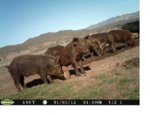
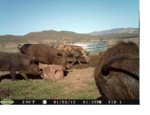
Group, the feral pig population on the Warner Ranch and vicinity continues to grow. Staff has observed at
least one group of feral pigs numbering in excess of 30 individuals on the Ranch in recent weeks. Damage
to range land and riparian areas on the Ranch has been observed and documented by District staff and
representatives from State Parks, the San Diego Natural History Museum, and the California Department of
Fish and Game (CDFG) (all members of the Feral Pig Group). At present, the pigs and their impacts appear
to be confined to the western boundary of the Warner Ranch, between the West Fork Valley and Henshaw
Dam. Anecdotal reports suggest that the pigs range widely between the Warner Ranch and other areas on
Palomar Mountain.
While previous discussions had suggested that it would be desirable to perform feral pig population and
distribution studies prior to engaging feral pig management activities, recent discussions among members
of the Working Group of the Feral Pig Group point out that pig populations and impacts on the Warner
Ranch are significant, and that it may be better to cull this population as soon as possible to relieve
expansion pressures, particularly to the north toward Riverside County. While the District retains the
prerogative to act in its own best interest on the Warner Ranch, the District can still work cooperatively
with the Feral Pig Group and its members since there is reason to believe that the Feral Pig Group would
support the District taking management actions at this time.
Board’s expressed desire to take action to mitigate this problem, District staff has begun to consider options
and issues associated with the preparation of a Feral Pig Management Plan for the Warner Ranch. General
Counsel has also been consulted and will participate in the Committee meeting via telephone.
DETAILED REPORT: An effective feral pig management plan for the Warner Ranch would most likely
be a multi-faceted approach which could include:
1) Periodic trapping;
2) Incidental take;
3) Seasonal hunting; and
4) Other activities in cooperation with the Intergovernmental Group on Feral Pig Impacts
Following is a brief description of these activities and associated issues:
Periodic Trapping
The trapping and dispatching of feral pigs is a permitted activity under a CDFG depredation permit. This
permit is described and compared with other permitted forms of pig take in the attached table “California
Department of Fish and Game Guidelines for Wild Pig Depredation” obtained from the CDFG website:
http://www.dfg.ca.gov/wildlife/hunti...predation.html. The District is eligible to obtain a Wild Pig
Depredation Permit for the Warner Ranch. A depredation permit would allow baiting a special corral with
a triggered gate and dispatching the captured feral pigs with firearms. This would be a periodic activity,
implemented as needed, but probably several times per year. It is felt that periodic trapping is likely to be
the single most effect means of managing feral pig populations, with the ability to cull the pig population
by 10 to 20 animals at a time. Options for the disposal of pig carcasses include salvage by District
personnel and/or donation to charitable organizations. It appears that the sale of pigs taken in this manner
would be prohibited.
Issues to discuss include: 1) designation of personnel authorized for the take of feral pigs on a District
depredation permit; 2) the development of plans and procedures for the activity; 3) equipment procurement
and personnel training; 4) safety and liability issues; and 5) carcass disposition. Another possibility might
include the District contracting this service to a third party.
Incidental Take
The District could authorize designated District personnel to carry a hunting rifle in their assigned District
vehicle for the purpose of dispatching feral pigs as they are encountered in the course of the employees’
normal duties on the Ranch. The intentional hunting of feral pigs by these designated personnel on their
own time could also be allowed. The former activity could be permitted either as part of the Depredation
Permit, or as allowed under "Immediate Take" as described in the attached CDFG guidelines. Intentional
hunting would be at the employees’ own discretion and would require that they obtain a sport hunting
permit and associated pig tag for any take. Under either scenario carcasses would either be harvested by
the employee or donated.
This option involves many of the same considerations for the District as periodic trapping. In addition, the
policy distinctions between dispatching pigs during work hours vs. allowing it on an employee’s own time
should be considered.
Seasonal Hunting
My Country Club, Inc., which presently holds the deer, turkey and upland bird hunting concessions on
District lands, could be allowed to engage in pig hunting in the same areas of the Ranch during those
associated hunting seasons. They would be required to follow all CDFG rules regarding the sport hunting
of feral pigs.
Other Activities
Other activities are undefined at this point, but would likely include the selective trapping, release, and tracking of feral pigs. Other potential activities might include non-standard hunting techniques, including
hunting with dogs, or, potentially aerial hunting from a helicopter (considered unlikely at this juncture).
ATTACHMENTS:
1) California Department of Fish and Game Guidelines for Wild Pig Depredation
2) Photographs of feral pigs taken on the Warner Ranch.