MIBowhunter
Well-known member
- Joined
- Nov 18, 2002
- Messages
- 2,089
- Reaction score
- 0
Wrestling a big fish
They net sturgeon to help them
May 13, 2004
BY ERIC SHARP
FREE PRESS COLUMNIST
CHEBOYGAN -- Big Bertha wasn't happy.
ERIC SHARP/DFP
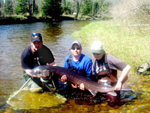
Jesse Hyde, left, Patrick Forsythe and Kristin Bott net a female sturgeon that weighed an estimated 120 pounds. Researchers are tagging sturgeon on the Black River in an effort to increase their numbers.
Six feet long and weighing about 120 pounds, the huge female sturgeon struggled hard enough to knock down two of the three fisheries researchers who netted her in the fast currents of the Black River. They were part of a project designed to increase the numbers of these fish, which haven't changed since the days of the dinosaurs.
Soaked to the shoulders, Patrick Forsythe and Jesse Hyde pulled the fish to the shallows by the riverbank while Kristin Bott opened a backpack. It held the plastic tags that would give the fish an identity.
"This is a big fish," Bott said as she hauled out the colored spaghetti tags Forsythe fastened to the dorsal fin far back on the sturgeon's shark-shaped body. "But we've seen a lot of big fish this year. A few days ago, we tagged eight fish that went over 90 pounds."
Forsythe is working on his doctorate and Bott on her master's degree in fisheries science at Michigan State University. Hyde, an Indian River resident, is a volunteer in a chapter of Sturgeon for Tomorrow that his mother, Brenda Archambo, helped start.
The volunteers help the scientists net fish and collect information. Just as important, they and Michigan National Guard troops patrol the river to protect the fish from poachers who are after sturgeon eggs, which can be turned into caviar and sold for more than $200 a pound.
"This is our sixth year," Archambo said. "Typically, we have about 350 volunteers who put in 3,800 hours patrolling the river during the spawning season. We are trying to take a long-term view that over the next 50, 75 years will bring this fishery back to where it was 150 years ago."
The state Department of Natural Resources estimates Black Lake's adult sturgeon population at about 550, give or take a couple of hundred. Archambo said she hopes her grandchildren will see a day when "tens of thousands of sturgeon" are swimming around Black Lake and nearby Burt and Mullet lakes.
"Look at Lake Winnebago, where Sturgeon for Tomorrow started," Archambo said of a Wisconsin lake. "Their management program got going in the 1950s, and they've gone from a handful of sturgeon to 35,000 today. I can see a day when we can have a sturgeon fishery here that will draw people from all over the world who want a chance to catch a 200-pound fish."
The Sturgeon for Tomorrow researchers take eggs from ripe females so they can study them. Earlier in the day, Forsythe put eggs in cages and lowered them to the bottom of the river. He hoped the experiment would show which creatures eat the most eggs.
This is the first of two sturgeon spawning runs in the Black River. The first usually takes place in April, when the water reaches 48 degrees, but this year it was delayed until May by unseasonably cold weather.
"The first run usually lasts about four or five days, then the fish drop back down to the lake," Forsythe said. "We usually get a second run in May, but that one is smaller, and the fish are gone after two or three days."
The volunteers and researchers also collect sturgeon fry, which hatch about one to two weeks after the eggs are laid. The fry will go to the state hatchery at Wolf Lake and be reared to a length of about 10 inches before they are returned to Black Lake.
Lake sturgeon are a primitive fish that can reach a weight of more than 300 pounds in the Great Lakes, but in Black Lake any fish bigger than 100 pounds is considered a jumbo.
Sturgeon probably live about 80-100 years and perhaps longer than 150. Females normally run up a river to spawn about once every five to seven years (perhaps a little more often for the Black Lake fish), and the males about every other year.
The fish don't begin spawning until about age 15 for males and 25-30 for females. The spawning fish are so big and easy to spot in the river, and it's so easy to see the colored spaghetti tags on fish that have already been captured, that by next year virtually every spawning sturgeon in Black Lake will be measured, weighed and tagged, Forsythe said.
For the egg-predation experiment, Forsythe squeezed a ripe female sturgeon until the bottom of a plastic bucket was covered with steel-gray eggs about the size of this letter "o." When salted, the eggs produce the caviar that makes the fish so high in demand.
It seems incongruous that such immense fish can come from such a tiny beginning, but the same-sized eggs give birth to the Eurasian beluga sturgeon, the world's largest freshwater fish. They can reach a weight of more than 3,000 pounds. A 2,700-pound beluga netted in 1924 produced more than 500 pounds of eggs. A 100-pound lake sturgeon easily can produce 10 pounds of eggs.
In 1880, Great Lakes sturgeon produced the bulk of the world's caviar, four million pounds a year sold mostly in Europe. Twenty years later, that figure had been reduced to 200,000 pounds by over-fishing and dams that prevented the sturgeon from reaching their spawning grounds.
Today, a New York firm sells beluga caviar from Iran and Russia on the Internet for $500 a pound. But it also sells lake sturgeon caviar from Canada for $230 a pound and smoked lake sturgeon flesh for $10.99 for four ounces, which explains why the fish are such tempting targets for poachers.
Spawning sturgeon are ridiculously easy to poach with a net or a spear. The fish move upstream in groups of two to 20, often resting in pools or slack water along the way.
They are highly visible as they move slowly up the river, and they are so oblivious of humans that they routinely bump into the legs of wading researchers.
When they reach the shallow, rocky areas where they spawn, with each massive female surrounded by a cluster of smaller but more aggressive males, the sturgeon thrash and splash with abandon. Their courtship rituals can often be seen a half-mile away.
Hyde said the DNR recently caught a man driving on a two-track along the river at 4 a.m. In the back of his truck were a tarp, a large net and a baseball bat. The man was arrested on a charge of driving with a suspended license.
"That's the reason we have people out here day and night," said Hyde, 19. "When these fish are spawning, they'd be so easy to wipe out. If you went out there at night with a light, you could empty the river."
They net sturgeon to help them
May 13, 2004
BY ERIC SHARP
FREE PRESS COLUMNIST
CHEBOYGAN -- Big Bertha wasn't happy.
ERIC SHARP/DFP
Jesse Hyde, left, Patrick Forsythe and Kristin Bott net a female sturgeon that weighed an estimated 120 pounds. Researchers are tagging sturgeon on the Black River in an effort to increase their numbers.
Six feet long and weighing about 120 pounds, the huge female sturgeon struggled hard enough to knock down two of the three fisheries researchers who netted her in the fast currents of the Black River. They were part of a project designed to increase the numbers of these fish, which haven't changed since the days of the dinosaurs.
Soaked to the shoulders, Patrick Forsythe and Jesse Hyde pulled the fish to the shallows by the riverbank while Kristin Bott opened a backpack. It held the plastic tags that would give the fish an identity.
"This is a big fish," Bott said as she hauled out the colored spaghetti tags Forsythe fastened to the dorsal fin far back on the sturgeon's shark-shaped body. "But we've seen a lot of big fish this year. A few days ago, we tagged eight fish that went over 90 pounds."
Forsythe is working on his doctorate and Bott on her master's degree in fisheries science at Michigan State University. Hyde, an Indian River resident, is a volunteer in a chapter of Sturgeon for Tomorrow that his mother, Brenda Archambo, helped start.
The volunteers help the scientists net fish and collect information. Just as important, they and Michigan National Guard troops patrol the river to protect the fish from poachers who are after sturgeon eggs, which can be turned into caviar and sold for more than $200 a pound.
"This is our sixth year," Archambo said. "Typically, we have about 350 volunteers who put in 3,800 hours patrolling the river during the spawning season. We are trying to take a long-term view that over the next 50, 75 years will bring this fishery back to where it was 150 years ago."
The state Department of Natural Resources estimates Black Lake's adult sturgeon population at about 550, give or take a couple of hundred. Archambo said she hopes her grandchildren will see a day when "tens of thousands of sturgeon" are swimming around Black Lake and nearby Burt and Mullet lakes.
"Look at Lake Winnebago, where Sturgeon for Tomorrow started," Archambo said of a Wisconsin lake. "Their management program got going in the 1950s, and they've gone from a handful of sturgeon to 35,000 today. I can see a day when we can have a sturgeon fishery here that will draw people from all over the world who want a chance to catch a 200-pound fish."
The Sturgeon for Tomorrow researchers take eggs from ripe females so they can study them. Earlier in the day, Forsythe put eggs in cages and lowered them to the bottom of the river. He hoped the experiment would show which creatures eat the most eggs.
This is the first of two sturgeon spawning runs in the Black River. The first usually takes place in April, when the water reaches 48 degrees, but this year it was delayed until May by unseasonably cold weather.
"The first run usually lasts about four or five days, then the fish drop back down to the lake," Forsythe said. "We usually get a second run in May, but that one is smaller, and the fish are gone after two or three days."
The volunteers and researchers also collect sturgeon fry, which hatch about one to two weeks after the eggs are laid. The fry will go to the state hatchery at Wolf Lake and be reared to a length of about 10 inches before they are returned to Black Lake.
Lake sturgeon are a primitive fish that can reach a weight of more than 300 pounds in the Great Lakes, but in Black Lake any fish bigger than 100 pounds is considered a jumbo.
Sturgeon probably live about 80-100 years and perhaps longer than 150. Females normally run up a river to spawn about once every five to seven years (perhaps a little more often for the Black Lake fish), and the males about every other year.
The fish don't begin spawning until about age 15 for males and 25-30 for females. The spawning fish are so big and easy to spot in the river, and it's so easy to see the colored spaghetti tags on fish that have already been captured, that by next year virtually every spawning sturgeon in Black Lake will be measured, weighed and tagged, Forsythe said.
For the egg-predation experiment, Forsythe squeezed a ripe female sturgeon until the bottom of a plastic bucket was covered with steel-gray eggs about the size of this letter "o." When salted, the eggs produce the caviar that makes the fish so high in demand.
It seems incongruous that such immense fish can come from such a tiny beginning, but the same-sized eggs give birth to the Eurasian beluga sturgeon, the world's largest freshwater fish. They can reach a weight of more than 3,000 pounds. A 2,700-pound beluga netted in 1924 produced more than 500 pounds of eggs. A 100-pound lake sturgeon easily can produce 10 pounds of eggs.
In 1880, Great Lakes sturgeon produced the bulk of the world's caviar, four million pounds a year sold mostly in Europe. Twenty years later, that figure had been reduced to 200,000 pounds by over-fishing and dams that prevented the sturgeon from reaching their spawning grounds.
Today, a New York firm sells beluga caviar from Iran and Russia on the Internet for $500 a pound. But it also sells lake sturgeon caviar from Canada for $230 a pound and smoked lake sturgeon flesh for $10.99 for four ounces, which explains why the fish are such tempting targets for poachers.
Spawning sturgeon are ridiculously easy to poach with a net or a spear. The fish move upstream in groups of two to 20, often resting in pools or slack water along the way.
They are highly visible as they move slowly up the river, and they are so oblivious of humans that they routinely bump into the legs of wading researchers.
When they reach the shallow, rocky areas where they spawn, with each massive female surrounded by a cluster of smaller but more aggressive males, the sturgeon thrash and splash with abandon. Their courtship rituals can often be seen a half-mile away.
Hyde said the DNR recently caught a man driving on a two-track along the river at 4 a.m. In the back of his truck were a tarp, a large net and a baseball bat. The man was arrested on a charge of driving with a suspended license.
"That's the reason we have people out here day and night," said Hyde, 19. "When these fish are spawning, they'd be so easy to wipe out. If you went out there at night with a light, you could empty the river."