EL CAZADOR
Kiss The Ring
- Joined
- Mar 26, 2001
- Messages
- 4,162
- Reaction score
- 12
DENISON, Texas — For Lone Star State bowhunter Lacy Harber, life has been a grand adventure of give and take.
The give? That's thanks to Harber's generous contributions to charities, wildlife conservation groups and philanthropic causes that have caught the Denison, Texas, resident's attention — and heart — down through the years.
In fact, after some childhood health problems, none of those worthy causes have captured his attention more than the famed Texas Scottish Rite Hospital for Children in Dallas, a place where Harber plans to leave nearly all of a vast financial estate.
The take? That has come on Harber's many globetrotting bowhunting adventures with his wife, Dorothy, for species ranging from the bongo and the leopard to the musk ox and the whitetail deer.
But in a lifetime of hunting from the sultry savannah of Africa to the windswept mountains straddling the border of China and the old Soviet Union to the frigid tundra above the Arctic Circle, what happened to Lacy last week may end up topping it all.
That's when the 69-year-old archer pulled his compound bow back and unleashed a Muzzy-tipped arrow at what may prove to be the biggest non-typical elk ever taken with a bow in the state of New Mexico.
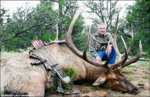
The bull, taken on the 550,000-acre Acoma Indian Reservation near Grants, N.M., on Sept. 7, is a staggering wapiti with a massive 7x6 main frame, complete with five abnormal kicker points.
Taped by Safari Club International scorer James Torivio Jr., the 7½-year-old bull weighed an estimated 1,100 pounds and boasts an SCI score of 411 4/8 inches as a typical and 425 2/8 inches as a non-typical.
"This was my most exciting hunt ever," Harber said. "Hunting elk when they're bugling with a bow is a challenging and exciting hunt, and I love that above all other hunts."
Harber should know, having started his hunting career as a farm boy with a .22-caliber rifle and a .410 shotgun in hand.
Hunting enthusiasts like Harber are anticipating an autumn of big antlers across the West this year. He and his wife, Dorothy, show off what could be the new non-typical New Mexico archery-record elk.
These days, however, with the exception of hunting upland birds and waterfowl with a shotgun, all of Harber's hunting adventures take place by way of the stick and string.
"I just enjoy a bow," Harber said. "I took up a Bear Kodiak recurve in 1958. That's when I started bowhunting and I've been bowhunting every since."
While Harber has taken a variety of dangerous game with his bow — a charging water buffalo from Australia had to be felled at six feet by Harber's hunting guides toting a .458 caliber rifle — elk hunting remains his greatest archery passion.
But despite a number of bow-killed elk under his belt, including some big bulls scoring well into the upper 300s, nothing could have prepared the Texas archer for the wapiti he did battle with a week ago in the Land of Enchantment.
It didn't start out that way, however.
"I was hunting the third day, but I hadn't heard many bugles," Harber admitted.
That's when the hunter's wapiti fortunes began to change.
"About three-quarters of a mile away, I heard some cows mewing, talking among themselves," Harber said.
"I had a Hoochie Mama call and I started calling. And after about three sets of calls, I got a bugle that answered me."
While most bowhunters would have tried to out duel the elk in a bugling contest, Harber is a big believer in doing just the opposite.
"I've found out over the years that you only use your bugle when you're trying to locate the bull," Harber said.
"Once you locate him, just put the bugle in your backpack. Because if you keep bugling, a big bull has got cows and most of the time they'll just move away from you.
"I just cow call once I locate the bull."
Doing just that, Harber and his guide, Sam Diswood, tried to lure in the lovesick elk over a period of about 45 minutes. Whatever sweet nothings they were calling out obviously must have worked.
"I believe he left his cows, because when I saw him first on the mountainside, he was by himself," Harber said.
With sunlight waning, the Texas bowhunter finally got a glimpse of the bull, a wapiti carrying headbones that could take the breath away from a hunter, even a seasoned one like Harber.
"I took my binoculars and I looked at him and I could see in just an instant looking at him that it was a monster bull," Harber said.
As the quartering giant closed ranks to within 38 yards, Harber drew and held for nearly a minute waiting for a shot opportunity.
When that opportunity finally came, Harber was able to thread his arrow through one lung and liver.
After watching the bull stop at 75 yards with the arrow buried up to its fletching, the giant wapiti slowly disappeared into the dark timber.
That led Harber and his guide to make a decision to ease out of the area and to give the elk time to expire.
While that decision to not push the bull undoubtedly led to a nervous night of sleep for Harber, he needn't have worried.
"Next morning at daylight, we went out," Harber said. "We found where he stood a good blood deposit there that was about as big around as a saucer."
From there, the tracking job was easy.
"We went in the trees and my wife found him about 75 yards into the trees," Harber said. "When the guides saw him, they just got on their knees.
"They couldn't believe it; they said they had never seen an elk like this."
Neither had Harber, who has hunted elk for more than 40 years, including 17 years on New Mexico's famed Baca Ranch.
"I thought this is just too good to be true," Harber said.
While nothing is official, yet — SCI trophy records specialist Gary Swingle hasn't received the paperwork — the bull appears to be as true as advertised.
In fact, the Harber bull could be destined to climb atop the New Mexico record books for bow-killed elk.
"With a bow, a 411-inch bull would be in the (SCI all-time) top-10," Swingle said. "As a non-typical (at 425 inches), it would also likely be a top-10 bull overall with a bow."
Swingle indicates the Harber bull may very well come in as New Mexico's No. 1 archery-killed elk — in either the typical or non-typical category.
The No. 1 archery typical in New Mexico was a 408 1/8-inch bull taken by Bruce Heare in 1998 in Socorro County, Swingle said. The top non-typical with a bow was taken near Winston, N.M., in 1999 by Joey Lang and it scored 424 1/8 inches.
Since Swingle says that a potential SCI all-time top-10 animal must be measured by a "master measurer" after a 60-day drying period, none of the figures for the Harber bull are etched in stone.
Likewise, the massive bull must dry 60-days before an official Pope & Young Club score can be obtained, as well.
A source with the Pope & Young Club indicated on Wednesday that, according to the newest P&Y record book (the sixth edition, published earlier this year), a 402 5/8 inch bull is the top non-typical elk listed from New Mexico.
ESPNOutdoors.com's conversion of the SCI scoring numbers into the Pope & Young scoring scale would appear to put the Harber bull in the 409 6/8 inch range.
Should those green numbers prove to be accurate, following the official P&Y scoring effort in November, the Harber bull could be the top non-typical elk listed in the P&Y Club's New Mexico rankings.
Additionally, the elk also could end up ranking in the Pope & Young Club's all-time top-10 list, perhaps as high as No. 8.
The P&Y source reiterated, however, that all such speculation is just that — speculation — until the bull completes the mandatory 60-day drying period and is officially measured.
What does the veteran Texas bowhunter do for an encore?
"I probably never will top this," Harber admitted.
But he plans to keep trying.
"Nothing is as exciting as hunting bull elk with a bow in the Western states," he said.
In fact, Harber allowed that if the Good Lord appeared and told him that he had one more bowhunting adventure left in his lifetime, there's little doubt what it would be.
"I'd like to get a bigger elk," Harber grinned.
Given his Land of Enchantment hunt a few days ago, that's a pretty tall order to fill.
-----------
photo courtesy of ESPN
The give? That's thanks to Harber's generous contributions to charities, wildlife conservation groups and philanthropic causes that have caught the Denison, Texas, resident's attention — and heart — down through the years.
In fact, after some childhood health problems, none of those worthy causes have captured his attention more than the famed Texas Scottish Rite Hospital for Children in Dallas, a place where Harber plans to leave nearly all of a vast financial estate.
The take? That has come on Harber's many globetrotting bowhunting adventures with his wife, Dorothy, for species ranging from the bongo and the leopard to the musk ox and the whitetail deer.
But in a lifetime of hunting from the sultry savannah of Africa to the windswept mountains straddling the border of China and the old Soviet Union to the frigid tundra above the Arctic Circle, what happened to Lacy last week may end up topping it all.
That's when the 69-year-old archer pulled his compound bow back and unleashed a Muzzy-tipped arrow at what may prove to be the biggest non-typical elk ever taken with a bow in the state of New Mexico.
The bull, taken on the 550,000-acre Acoma Indian Reservation near Grants, N.M., on Sept. 7, is a staggering wapiti with a massive 7x6 main frame, complete with five abnormal kicker points.
Taped by Safari Club International scorer James Torivio Jr., the 7½-year-old bull weighed an estimated 1,100 pounds and boasts an SCI score of 411 4/8 inches as a typical and 425 2/8 inches as a non-typical.
"This was my most exciting hunt ever," Harber said. "Hunting elk when they're bugling with a bow is a challenging and exciting hunt, and I love that above all other hunts."
Harber should know, having started his hunting career as a farm boy with a .22-caliber rifle and a .410 shotgun in hand.
Hunting enthusiasts like Harber are anticipating an autumn of big antlers across the West this year. He and his wife, Dorothy, show off what could be the new non-typical New Mexico archery-record elk.
These days, however, with the exception of hunting upland birds and waterfowl with a shotgun, all of Harber's hunting adventures take place by way of the stick and string.
"I just enjoy a bow," Harber said. "I took up a Bear Kodiak recurve in 1958. That's when I started bowhunting and I've been bowhunting every since."
While Harber has taken a variety of dangerous game with his bow — a charging water buffalo from Australia had to be felled at six feet by Harber's hunting guides toting a .458 caliber rifle — elk hunting remains his greatest archery passion.
But despite a number of bow-killed elk under his belt, including some big bulls scoring well into the upper 300s, nothing could have prepared the Texas archer for the wapiti he did battle with a week ago in the Land of Enchantment.
It didn't start out that way, however.
"I was hunting the third day, but I hadn't heard many bugles," Harber admitted.
That's when the hunter's wapiti fortunes began to change.
"About three-quarters of a mile away, I heard some cows mewing, talking among themselves," Harber said.
"I had a Hoochie Mama call and I started calling. And after about three sets of calls, I got a bugle that answered me."
While most bowhunters would have tried to out duel the elk in a bugling contest, Harber is a big believer in doing just the opposite.
"I've found out over the years that you only use your bugle when you're trying to locate the bull," Harber said.
"Once you locate him, just put the bugle in your backpack. Because if you keep bugling, a big bull has got cows and most of the time they'll just move away from you.
"I just cow call once I locate the bull."
Doing just that, Harber and his guide, Sam Diswood, tried to lure in the lovesick elk over a period of about 45 minutes. Whatever sweet nothings they were calling out obviously must have worked.
"I believe he left his cows, because when I saw him first on the mountainside, he was by himself," Harber said.
With sunlight waning, the Texas bowhunter finally got a glimpse of the bull, a wapiti carrying headbones that could take the breath away from a hunter, even a seasoned one like Harber.
"I took my binoculars and I looked at him and I could see in just an instant looking at him that it was a monster bull," Harber said.
As the quartering giant closed ranks to within 38 yards, Harber drew and held for nearly a minute waiting for a shot opportunity.
When that opportunity finally came, Harber was able to thread his arrow through one lung and liver.
After watching the bull stop at 75 yards with the arrow buried up to its fletching, the giant wapiti slowly disappeared into the dark timber.
That led Harber and his guide to make a decision to ease out of the area and to give the elk time to expire.
While that decision to not push the bull undoubtedly led to a nervous night of sleep for Harber, he needn't have worried.
"Next morning at daylight, we went out," Harber said. "We found where he stood a good blood deposit there that was about as big around as a saucer."
From there, the tracking job was easy.
"We went in the trees and my wife found him about 75 yards into the trees," Harber said. "When the guides saw him, they just got on their knees.
"They couldn't believe it; they said they had never seen an elk like this."
Neither had Harber, who has hunted elk for more than 40 years, including 17 years on New Mexico's famed Baca Ranch.
"I thought this is just too good to be true," Harber said.
While nothing is official, yet — SCI trophy records specialist Gary Swingle hasn't received the paperwork — the bull appears to be as true as advertised.
In fact, the Harber bull could be destined to climb atop the New Mexico record books for bow-killed elk.
"With a bow, a 411-inch bull would be in the (SCI all-time) top-10," Swingle said. "As a non-typical (at 425 inches), it would also likely be a top-10 bull overall with a bow."
Swingle indicates the Harber bull may very well come in as New Mexico's No. 1 archery-killed elk — in either the typical or non-typical category.
The No. 1 archery typical in New Mexico was a 408 1/8-inch bull taken by Bruce Heare in 1998 in Socorro County, Swingle said. The top non-typical with a bow was taken near Winston, N.M., in 1999 by Joey Lang and it scored 424 1/8 inches.
Since Swingle says that a potential SCI all-time top-10 animal must be measured by a "master measurer" after a 60-day drying period, none of the figures for the Harber bull are etched in stone.
Likewise, the massive bull must dry 60-days before an official Pope & Young Club score can be obtained, as well.
A source with the Pope & Young Club indicated on Wednesday that, according to the newest P&Y record book (the sixth edition, published earlier this year), a 402 5/8 inch bull is the top non-typical elk listed from New Mexico.
ESPNOutdoors.com's conversion of the SCI scoring numbers into the Pope & Young scoring scale would appear to put the Harber bull in the 409 6/8 inch range.
Should those green numbers prove to be accurate, following the official P&Y scoring effort in November, the Harber bull could be the top non-typical elk listed in the P&Y Club's New Mexico rankings.
Additionally, the elk also could end up ranking in the Pope & Young Club's all-time top-10 list, perhaps as high as No. 8.
The P&Y source reiterated, however, that all such speculation is just that — speculation — until the bull completes the mandatory 60-day drying period and is officially measured.
What does the veteran Texas bowhunter do for an encore?
"I probably never will top this," Harber admitted.
But he plans to keep trying.
"Nothing is as exciting as hunting bull elk with a bow in the Western states," he said.
In fact, Harber allowed that if the Good Lord appeared and told him that he had one more bowhunting adventure left in his lifetime, there's little doubt what it would be.
"I'd like to get a bigger elk," Harber grinned.
Given his Land of Enchantment hunt a few days ago, that's a pretty tall order to fill.
-----------
photo courtesy of ESPN