NatureDriven

Well-known member
Joined
Aug 17, 2003
Messages
591
Reaction score
6
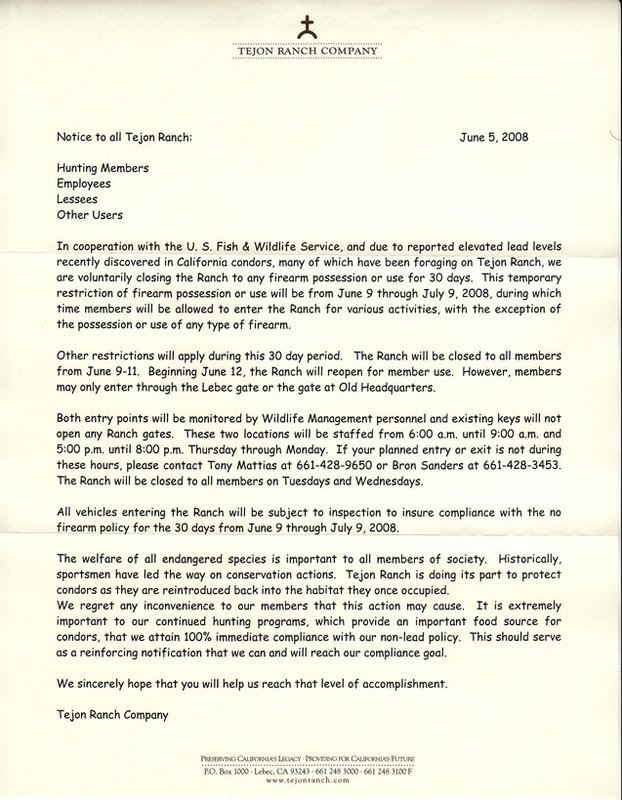
TejonRanchClosing.jpg
 

spectr17

Administrator
Admin
Joined
Mar 11, 2001
Messages
70,011
Reaction score
1,007
I've been told the condors are/were feeding at the boneyard, a well know place where the hog remains are dumped at Tejon. Sposed to be something like 24 condors feeding there now.
 

Rancho Loco

Well-known member
Joined
Jan 29, 2002
Messages
5,546
Reaction score
3
I'll go ahead and say it - I think Tejon is wanting the gutpiles buried, and are doing the 30 day halt on hunting to push the condors off the property, and I really can't blame them. Hunters are going to keep shooting lead despite any law and because of the messed up way it was brought about. With the GPS units on the birds, if they pick it up on the ranch - ban or no ban, Tejon is screwed.

Text books should be written about how this whole thing was screwed up beyond all recognition.
 

Speckmisser

Well-known member
Joined
Mar 12, 2001
Messages
12,900
Reaction score
27
Dang, Rancho... I hadn't thought about that angle.

It's definitely worth consideration (and no, that's not a facetious response).

If true, I doubt we'll ever hear it, though.
 

socalkid

Well-known member
Joined
Sep 30, 2007
Messages
666
Reaction score
8
I recieved the same letter today also.

I wonder why they have the closures on Tuesdays and Wednesdays??
 

cam188

Well-known member
Joined
Oct 3, 2006
Messages
581
Reaction score
0
I need an expert to answer since I may not be qualified.
Here goes.

1. How many gut piles have bullets or frags still left in them?
2. How much lead needs to be ingested to be assimilated into the bloodstream of a condor for it to die of lead poisoning?
3. How many bullets have been found in the guts of dead condors?

People and other animals live out there life with bullets and fragments in them. I don't think that copper jacketed rounds ingested would cause lead poisoning. Are all these animals gut shot? There are lot of other factors that are very fishy with this whole lead killing condors. Where are all the dead turkey vultures and other scavengers eating the exact same gut piles etc... They are not showing up dead of lead poisoning.

Also when we talk about the condor range. Most hunters don't leave bullets in the animals they hunt and there are not enough predator hunters out there to make an impact on condors.

My guess is that if it is lead poisoning it is coming from some water source. Oh and is ingesting copper rounds any better?

Just some things to think about. Unfortunately most of our federal and state biologists are liberals and will lie for their cause.
 

cam188

Well-known member
Joined
Oct 3, 2006
Messages
581
Reaction score
0
Found This.

Lead as a Poison
It is quite clear from what has been mentioned above that lead was all around us, principally in lead paint and in tetraethyl lead. Now, lead is a systemic poison, but its use in paint and motor fuel was thought safe because nobody ate paint or scraped it into their coffee, and there was lots of air to dilute the lead coming out of exhaust pipes. However, it was finally realized that children did eat paint, and were extra sensitive to lead in the air, and while this had no serious health effects, it seemed to make them stupider than they would otherwise be. This was an excellent reason to reduce the lead in the environment, and that has been done. Paints now use other pigments, such as titanium dioxide, and tetraethyl lead has been banished from motor fuel, which would be a good idea anyway, as easier on engines. This may have saved several lives a year. Now, if the cars were banished instead, we would save 40,000 lives a year.

Acute lead poisoning results from ingesting soluble lead compounds. The symptoms were called "painter's colic" since painters, covered with white lead, were at risk. The damage appears to be mainly to the nervous system, and the effects not as acute as those of mercury poisoning. Lead is an accumulative poison, building up until it reaches a toxic level. An antidote after swallowing a soluble lead salt is a stiff drink of epsom salts, MgSO4, which precipitates insoluble PbSO4.

Lead pipes were once used for household water. Lead pipe was easy to form by casting or extrusion, and easy to join by fusion. A mixture of litharge, glycerine and linseed oil made "plumber's cement" that could be used for joining pipes without heat. With hard water, a layer of sulphate or carbonate forms on the lead, and lead does not enter the water. With soft water, as from cisterns, this protective layer does not form, and a dangerous amount of lead can dissolve in the water. Since lead pipes were widely used in Roman times, some experts have concluded that they poisoned the populace rather generally. In fact, Vitruvius shows that the hazard was appreciated, and steps taken to reduce it.

Copper tubing is joined with solder, which usually contains lead. The amount of lead that comes from soldered tubing connections is vanishingly small, and no hazard, but nevertheless it is deprecated. Even fishing sinkers of lead have been banned, which shows an excellent lack of appreciation of the degree of hazard. Actually, what gave the most worry was simply lost and discarded lead bits. Just good sense would show that it is necessary to be wary of unusual concentrations in the environment and to correct them when discovered.

There is no risk at all in handling lead metal. It cannot be absorbed through the skin or the respiratory tract. Dilute hydrochloric acid has little effect on it, so the lead would pass through the stomach before any damage was done. Eating lead is probably safe, but not encouraged. Carbonated water dissolves lead to some degree. Food and drink should never touch lead, since organic acids, such as acetic acid, may dissolve lead. Lead is, on the whole, very much less a hazard than mercury. It was made dangerous by its widespread use in paint and motor fuel, and that is now past.
 

Rancho Loco

Well-known member
Joined
Jan 29, 2002
Messages
5,546
Reaction score
3
Cam - please cite the source.

And I would point out - some very suspect info is in there.
 

Speckmisser

Well-known member
Joined
Mar 12, 2001
Messages
12,900
Reaction score
27
Cam, a couple of things get sort of glossed over in the info you cited...

But first...
<div class='quotetop'>QUOTE </div>
1. How many gut piles have bullets or frags still left in them?
2. How much lead needs to be ingested to be assimilated into the bloodstream of a condor for it to die of lead poisoning?
3. How many bullets have been found in the guts of dead condors?[/b]
Question 1: The lead that most enviros are concerned about is mostly lead dust and microscopic fragments, in addition to the larger pieces. I don't know how many animals you've cut up, but some of the older lead bullets, as well as some of the stuff like Ballistic Tip ammo, leave a lot of particles behind. Once that jacket peels back, that lead is passing through tissue at a pretty high rate of speed, and the little bits spread out through the tissue in a pretty big pattern. Point is, it's not just the guts, which may or may not contain lead (but usually do if the shot was to the "vitals"). Leaving the spine, busted shoulders, or neck and head means you're leaving lead in the environment.

Question 2: I don't know the specific amount of lead that must be ingested to cause a toxic level in the blood. The concentration is pretty well documented, though... and while I don't have it off the top of my head, it is available for you if you choose to do the research. Check the Peregrine Fund site, for one, although remember they tend to err to their own agenda. The science itself is pretty hard to refute, though.

Question 3: Refer back to question 1. While there have been occasions where lead shot and bullet fragments were found in the crop and esophagus of condors, most of the issue isn't with visible hunks of lead... it's with those little, teeny bits. However, in addition to lead that may or may not have come from bullet fragments, condors are notorious for eating odds and ends that look like food... including lead tire weights and bits of metal from old cans and wiring that have lead components. Point is, though, nobody is saying there are whole bullets in the animal. It's the little tiny bits that add up incrementally.

Now to your second post.

First of all, you can't compare condors to humans. Most mammals tend to pass impurities like lead pretty quickly. There's a pretty nominal opportunity for toxicity to occur. However, birds like the condor hold lead particles in their crops, which give the lead time to enter their bloodstreams.

Also, lead toxicity is cumulative. The body doesn't detoxify from lead, just as it doesn't pass along heavy metal poisoning. Once the lead enters the system, it stays there unless it's removed via chelation therapy. So while the condors may only ingest tiny amounts from a single food source, it's entirely possible that they do ingest enough over time to become toxified. Since the check-ups only occur annually, that gives these birds an entire year to eat enough lead fragments to become statistically lead-poisoned.

So yes, the facts DO support the argument that lead ammo does pose some risk (emphasis on SOME) to condors and other carrion eaters.

However, as your second post points out, humans face very little risk from eating wild game that has been shot with lead ammunition. It's a separate but equal discussion, of course, given recent events in North Dakota, Minnesota, and Idaho.

OSHA requires that any workplace provide the Material Safety Data Sheets (MSDS) for any chemical or compound that people can encounter in the workplace. Lead is one of those, and it takes only a quick read of the MSDS to see that lead ingestion is the most insignificant way to get lead toxicity. Vaporized lead, such as that released by firing modern ammunition at the range, and soluble lead such as that in paint and gasoline, are the most common culprits in lead poisoning in humans.

Anyway, at this point the argument about lead ammo's impact on condors is pretty much moot. The law has passed and now you're just gonna have to deal with it.

However, you can bet that you're gonna see new laws based on the risk to human health. Fight them. Until someone can provide some significant evidence that there's a human health risk to using lead ammo, these claims and concerns (as expressed in North Dakota and Minnesota) are baseless. Don't let them pass new laws based on panic induced by sensationalists and agenda-driven public relations (e.g. Peregrine Fund, Sierra Club, Humane Society, etc.).
 

easymoney

Well-known member
Joined
Jan 16, 2003
Messages
10,522
Reaction score
101
"I'll go ahead and say it - I think Tejon is wanting the gutpiles buried, and are doing the 30 day halt on hunting to push the condors off the property, and I really can't blame them. Hunters are going to keep shooting lead despite any law and because of the messed up way it was brought about. With the GPS units on the birds, if they pick it up on the ranch - ban or no ban, Tejon is screwed."

"Text books should be written about how this whole thing was screwed up beyond all recognition. "

Have to agree with you 100% on this one, rancho.
And with mr missers last two paragraphs.
It is very interesting that this "crisis" can be pinpointed to one place and to one source of the supposed poisoning, all of a sudden. Yet no evidence has been proved that the lead from these "gut piles" are the ones that is killing just the condors.
The political and emotional agendas are what is feeding this in place of real facts. Tejon Ranch is probably going to be the whipping boy for many reasons and there is not much now to be done. The appointed LA county planning and DFG commissions are singling out this property and they will not budge.
I think the word used was "moot"...
 

betelgeuse

Well-known member
Joined
Apr 9, 2006
Messages
944
Reaction score
9
<div class='quotetop'>QUOTE (spectr17 @ Jun 9 2008, 06:42 PM) <{POST_SNAPBACK}></div>
I've been told the condors are/were feeding at the boneyard, a well know place where the hog remains are dumped at Tejon. Sposed to be something like 24 condors feeding there now.[/b]


If this turns out to be true then Tejon is pretty lame for letting this take place.
 

cam188

Well-known member
Joined
Oct 3, 2006
Messages
581
Reaction score
0
Can't find the source. It was from a university if I recall next time I cite a source I will post it.

As for human vs bird of course there are differences but......
Turkey vultures and condors are on the same level geneticly. So wear are all the dead vultures?

I personaly don't have an issue of a lead ban I just don't think it is a good reason for the condor issues. I hunt with a bow anyway.
What happens when copper levels are too high?

I wonder what the lead levels are in all of our waterfowl preserves?

I just wish we had more people on our side fighting as hard as the "environmentalists" are.

When things are to be banned I want the research paperwork. Hard data, proof. Not hypothesis.

They did not research long or hard before there ban. I want years of proof.

Just look at the CARB Data for offroad motorcycle pollution. When they first inacted the RED sticker they claimed they had this huge study with actual air quality sample from offroad riding areas etc. Well turns out they never took one air sample. But we still let them get away with this red sticker nonsence.

This is me just venting at nonesene.
Carry on.
Rant over for now lol....
 

grtwythunter

Well-known member
Joined
Apr 22, 2001
Messages
1,907
Reaction score
0
Here's the easiest solution I can think of.......use the GPS collars for something other than finding their dead gooneybirds. Follow them, find out what they're eating, then boot them off the carcass and test it for lead......way too easy, eh? IMHO they don't want anyone to know where the lead is coming from. There's way too many biologist's jobs at stake and we're the easiest scapegoats out there. I sure would like to see SCI or the NRA step up to this one.

My prediction is even after 50 years of lead ammo bans, condors will still be dying from lead and it will still be our fault and all the biologists involved in the condor recovery will be living well in retirement.

Scott
 

MJB

Well-known member
Joined
Dec 20, 2004
Messages
1,258
Reaction score
17
Closed on Tuesday & Wednesday????? I don't get it.

Monitor Condors?

Developer Days?

Staff days off?

Give the game/condors/livestock a rest?

Anybody know why?
 

Speckmisser

Well-known member
Joined
Mar 12, 2001
Messages
12,900
Reaction score
27
This is just a guess, but I'd venture that the closure has more to do with the cost of staffing two gates every day of the week. Several of the office staff are part-time employees, so this added requirement (gate checks) is going to require someone to put in more hours.

As to some of the other stuff... I'm still contemplating Rancho's theory. In a warped kinda paranoid way, it makes sense.
 

MJB

Well-known member
Joined
Dec 20, 2004
Messages
1,258
Reaction score
17
That's some profound stuff by two of the intouch people.

I know Rancho is on the right track.....that was the first thing that popped into my mind. Stop the gut piles and stop the birds from eating on the ranch. But it still sucks my 204 is jujst wanting to kill some Varmits!!
 

ooja

Well-known member
Joined
Oct 28, 2004
Messages
192
Reaction score
1
The article that Cam gave us can be found at:

http://mysite.du.edu/~jcalvert/phys/lead.htm

I am not familiar with the article, I just have a knack for finding things. I don't care to look up the reference information though.

Thanks Speck, I finally understand why the lead affects the condors differently than the other animals. Now some of it makes sense to me.
 
Top Bottom