Fighterjock
Member
- Joined
- Jun 15, 2012
- Messages
- 7
- Reaction score
- 0
Just got back from a four day hog hunt in south Texas. Southwood Ranch—about 2.5 hours south of Houston.
I went with a group of guys (and one gal) with whom I’ve hunted in the past—mostly prairie dogs—in AZ and WYO.
The guy who organized this hunt has been a guest there for many years and has a great relationship with the owner—who has deep roots in the region dating back to a time before the Texas Revolution.
We had a total of 8 hunters. The property is approximately 2200 acres. There are no high fences, so game comes and goes at will.
Almost all hunting for hogs is done at night—so having a cooperative moon/sky conditions a must. As mentioned, there was a total of 8 hunters—and we paired up each night and rotated areas every day. I hunted from deer stands for the first two nights. I saw three HUGE hogs the first night but blew the chance when I made contact between the window frame and my barrel as I was trying to adjust for a shot—and realized in my zeal for safety I’d forgotten to chamber a round after climbing up the ladder to the stand. That one hurt! They truly were monsters.
Second night—rotated stands and saw at least 30 deer. No pigs. The crew that manned our vacated stand from the night prior bagged a hog though—so the night was productive. Others were sighted but no opportunity to shoot.
During the day—after a truly generous breakfast and slaking one’s fill of java—most of us turned out to do some fine tuning on the rifle range—or go scouting. It was my first visit to the ranch, so I deferred the shooting for the afternoon and went scouting late morning of each day.
Found a lot of sign the first time I went out (second day at the ranch)—always near water. The area we scouted was generally east and north of the ranch house. After getting skunked on the second night (now day three) a group of four of us scouted the south/west boundaries of the ranch and found “hog heaven”. It was a seasonal creek that was once the actual course of the San Antonio river. In general it was bounded on each side by a defined levee system. The distance from the tops of the levees was probably a few hundred yards, but where the actual/recent flow was about 50-75 feet across and about 15-20 feet below the levee tops. As we found it—it was not flowing, but 90% mud (very deep/thick clay like) with some small areas of brackish standing water. It had flowed earlier in the year so some of these little ‘ponds’ still had fish in them—some were big enough to splash and thrash. This got my attention and certainly the same went for the hogs. Tracks went in/out of this area were fresh and numerous. The kicker about this spot was the HUGE hog wallow we found. You could actually make out the imprint of a hog that had been there recently (the night before) and it was BIG.
So, one of the other guys (Justin—former US Army marksman/sniper) and I decided to forego the deer stand for our next hunt and instead to go ‘tactical’. After scouting thoroughly, we made a plan for the evening hunt to go down to ground level right above that active wallow.
We had a lot of time to plan this out—so we brought a pop up blind down to one spot during the day and let it “settle”. We arrived back on site for the hunt about 45 minutes before sunset—and we ended up using every minute of it to finish setting up.
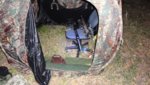
I was in the pop up blind with two clear lanes of fire—each about 20 to 30 degrees across and not more than 40 yards deep. That means I was about 20 yards from the near edge of the creek bottom. Justin initially set up in a “ghillie suit” sitting in the open against a tree—about 100 feet to my left and even closer to the wallow. We’d spiked the place with a lot of deer corn and had piles that were placed tactically—with hopes of getting them to stop right in the shooting lanes. We each had AR-15’s. He had a .45 pistol w/night sights as well. I had the room—so I brought my .375 Ruger African into the blind with me. Bog pod for support in my primary lane and a fold up set of shooting sticks for the other.
I should mention too that it was my turn to try out the Pulsar N550 digital night scope on my AR. This is a great setup—but in my case particularly—not easy to move around with. My AR is configured with a Stag model 6 upper in .223 with a heavy contour free floated 24” stainless barrel. The N550 is a BIG scope and combined I’d guess that rig weighed about 15 pounds with a full magazine. BTW, I’d zeroed it at the range (literally—100 feet outside the trailer where you stay while hunting) and had SUPREME confidence in it. Turns out—that using it during the day is MUCH easier than at night—esp. because of the dynamic nature of sitting in the dark with a full moon that was sometimes obscured by high clouds or low fog…
Justin and I had a good plan—a safe and well defined set of shooting lanes—and all the right gear. What we didn’t have initially was a way to communicate. His position was just over 100 feet to my left, slightly downhill and completely obscured in the dark. Luckily I had about 100 feet of light cord with me—so we decided to run a line between us—and use it to communicate with a hastily agreed upon set of signals. Three pulls = “I have hogs in sight/able to engage”. A reply of one pull = “I am not in a position to engage”, a reply of three pulls = “I am ready to engage”. The final signal of three pulls meant “I acknowledge—commence firing in THREE—TWO—ONE”. But of course—as I strung out the line from my blind I discovered we were about 120 feet apart. What to do? Luckily there is a vine growing wild right in the bottom land so we cobbled together about 25 feet of it and we were all set to go.
Sunset was at about 5:30 and moonrise wasn’t until over an hour later. Sunrise/sunset times vary gradually—not so the moon. The moon came up a full 50 minutes later on this night than the previous night—and when combined with our low position in relation to the horizon and the cover of trees made it REALLY DARK—and relatively quickly. We were in place and settling in just a few minutes after official sunset.
I spent the next hour + practicing with the night scope (eats batteries like crazy—so I limited power on cycles to just a few minutes). I also practice moving “whisper quiet” from one shooting lane to the next with a 15 pound rifle. I failed miserably on my first attempt—successfully knocking my tripod over. Luckily it was just twilight—so no damage done. I’m slowly tuning my senses to the quiet—to the sounds of the forest/hollow and going over various scenarios of engagement. Frontal, crossing, far bank, right side, etc. Now it’s a waiting game. Stay relaxed—but remain vigilant.
So, fast forward…It’s now just before 8 o’clock and I feel a huge tug (just one) on the blind. WTF? Did I snag/snare a deer? A small pig? Chupacabra?
No—it was Justin—a combat veteran who has kicked down doors in Afghanistan BTW—coming in. It was just too damned dark in his position. As he firmly stated: “This is a safety issue—mine!”
It was so dark that he literally put his AR down by his side—and with his back sitting against a tree he broke out his .45 and held it in the ready position. I failed to mention that our firing positions were on or right next to major game trails—and the only way in/out of the creek in this stretch of the holler was via these game trails. He was only 30-40 feet (max) from the wallow—and if a hog boogered out of there he would be completely exposed—at ground level—in almost complete darkness. I’m surprised he stayed as long as he did…
So, we settled in—him to my left at about 3-4 feet—outside the blind (all windows doors open since it’s so dark). We sit without much going on for about 30 minutes—moon is rising and the light is coming up. Next thing you know—we can hear hogs. My hearing ‘radar’ puts them in two places—10 o’clock at over 100 yards and back at my 4-5 o’clock across the creek or in the creek (50 yards max). In other words—they’ve executed an almost perfect pincer movement on us…
I can hear the right/aft group crunching—snorting, etc. but it’s not steady. They make noise—stop for a minute or two—make noise, etc. I sense them feeding toward us—through the bottom and coming in behind us on the same bearing. I hear one distinct “grunt”—then nothing. It had to have been inside of 20 yards.
It was quiet for almost 30 minutes—when the stillness was cracked with the “BOOM!” of a rifle. Someone in the deer stand (above/behind us about 60 yards) had taken a shot. Before anyone goes all 'safety' on me--we had VERY CLEAR Rules of Engagement--and they were facing 180 degrees away from us. They would not shoot aft of their 3-9 o'clock--nor could they realistically since there was only thick brush and timber behind them.
In any case...we listened for a follow up—but there was none. Out here the rule is to ‘pay the insurance’ EVERY time. More than one hunter has ‘stoned’ a pig where it stood, only to have it jump up and run off seconds (or in one case over ten minutes) later. There was no follow up shot—and so we began to wonder—did it run? Was it a coyote? (not likely to blow a pig hunt for a coyote). After a few minutes and no other shots we were ready to break cover—thinking the hunt had been at least temporarily busted. (Later that night we determined that we’d kicked up what turned out to be three pigs towards our companion hunters (again--about 60 yards behind us—facing toward the grass and deer feeder)—and they bagged one of them. I think it was those pigs I heard that were off to my right and close in).
Then, something came over me—a sense if you will—that we should stay put and just send a text message. Yes, the light from the phone would highlight us—but if you throw a jacket over your head—the illumination is knocked down 95%. So Justin typed away and hit “send”.
Good thing we didn’t move…2 minutes later—and not more than that--we heard pigs nearby.
This is where it got REAL interesting. In the next 40 minutes or so—we heard—then began to see hogs. How many? Hard to say—at least 4—likely many more. I was in the blind with the night vision scope. I could make out the corn—the piles especially—but when I boosted the view by engaging the IR illuminator—it revealed two things. One: the big pile of corn I’d been focused on was actually in Justin’s original shooting lane—and was completely obscured by dead branches about 5 feet thick. This was NOT apparent without IR illumination. The other issue is that the gain on the scope is VERY sensitive—and activation of the illuminator would cause huge “shadows” to be cast. In the IR illuminator mode, if you adjust to see what it illuminates best—you lose the fine detail and literally cast shadows that could be hiding what you’re after. So, lesson learned. I didn’t have the opportunity to use this in practice other than daytime or early in the evening—and never against a ‘live target’. This is a great piece of gear—and with just 10 minutes of real world simulation I’m sure I would have been MUCH less frustrated with my inability to find the hogs later on.
Earlier, when we had a lull—I’d asked Justin to scout through his rifle scope and asked him if he could make out the corn in the holler. The reply: “barely”. Knowing how good my binoculars are in low light (I’d just looked at the same thing—and the corn glowed like small embers) I had him take a look through them. Needless to say—I didn’t get them back that night!
We were now hearing a LOT of movement—and Justin spotted—one, two—no…THREE shoat sized hogs on the corn across the way. In fact—at one time, they were all lined up (I later learned). But I could NOT find them from where I was sitting. There were other hogs moving—neither of us could see them but one just sounded BIG—and then Justin saw it. It was trotting in and out of cover, across the bank—almost as if on patrol. Then it would come back down into the area near the wallow—and much on the corn. We could hear it when it stopped—but not see it.
Now the pitch of the potential battle is ramping up—as is my level of frustration. I can NOT see those far hogs on the corn. Tried the IR illuminator once—then again—and Justin (rightly so) softly barks—shut that thing off! Turns out—it puts out a small amount of visible red light and we think had alerted the hogs. Imagine each side—you see them, naked eye at times—and the dummy right next to you can’t find them with a high tech piece of night gear. Then there’s the “dummy” who feels like he should be riding the short bus—equipped with the high end gear—set up perfectly, etc. and CANNOT see the “they’re RIGHT THERE hogs”…
So—I take a DEEP breath and ask—where are they in relation to the tree? (there was an 8-10” wide and very tall tree in the center of the shooting lane). Justin slowly leaned into the blind—got on my sight line with the bino’s and in a hammered whisper announced: “Right behind the FU%*ING tree!”
Quick thinking on his part—we both (whisper quiet) agreed that I had to get out of the blind. He set his rifle across the line of sight on its bipod and dropped mine in at 90 degrees. Instant prone rest. So—we reset positions—hogs are moving—closer yet—and I STILL CAN’T SEE them! WTF?
Turns out—that in the prone position—there was a large deadfall about 10 feet ahead of us. Kneeling—you could spot them—prone—you couldn’t. Finally—a hog steps right out in the lane—on the near bank (maybe 25 yards) and starts to hammer on the corn. Needless to say our communication has become rather ‘charged’ by now—and I’m pretty pressurized. We’re not being whisper quiet—but not talking loud. As I break the prone position—I look up and FINALLY SEE this big old hog—right there! I’d told Justin earlier—in this environment—no prisoners. Too risky. Either the hog runs or charges so if I shoot once—I’m shooting five.
I don’t know how long it took—maybe a second…but I shouldered that beast—and as I did I could see that Justin was just ITCHING to drop this thing. Thank goodness he was a GREAT sportsman—and went to the ready and waited. That wait was all of a heartbeat—because I shouldered/sighted and squeezed in about that much time. One heartbeat…
It’s amazing how acute your senses and timing become when you’re dialed in for a few hours. I shoot and almost simultaneously I see/hear/feel Justin’s AR crack one off. Ironically—I’m left handed—and he’s on my left. We are no more than two feet from each other. In the next 3 seconds or so—I followed with three rounds—and Justin another—followed immediately by my fifth. Talk about a melee. Hot brass hitting him—hot brass hitting me--hogs start busting out—squealing and crashing in the brush. The NV scope flares during the muzzle flash—but apparently recovers quickly. It also obliterates the night vision in your aiming eye. I can honestly say all my shooting after the first round was instinctive—and probably not needed—but who knows. What I DO know is that hog went no more than a few steps after wheeling away on the impact of the first rounds. It turned about 90 degrees and dropped right down in the mud and began to slowly sink.
I was amazed though—as we both stand up to say “congrats” (quiet elation) we see yet ANOTHER hog walk into the shooting lane—if only for a second—then it busted out like it’s tail was on fire. I took another look through the NV scope for other hogs—and noticed that the one we dropped was still flopping an ear. I steadied the rifle and put one right behind the ear—and that finished it. We figured that there were indeed at least 5 and probably many more hogs in and around the scene of the engagement.
Rifles loaded and safe—but ready, we walked/plodded in to see what turned out to be a HUGE hog (by my standards anyway) and here’s the kicker—no “catcher’s mitt”, no “sack”…it was a SOW. The head was HUGE—and the rest of it was just plain big. Believe it or not—we heard at least one, if not two other hogs nearby—this is after standing up, talking in a normal voice (okay—maybe a “little bit” enthusiastic) and wearing my head lamp with bright xenon beams blazing away. There is a future for this place I reckon…
We did a post mortem and found 6 bullet strikes…not counting the ‘insurance’ shot. In addition to follow up shots—the rule here is to shoot in the head. A shoulder/lung shot hog WILL RUN—and in most places, very thick cover is only a few short paces away. There were three strikes in the head/spine area one toward the shoulder and two prominent “Texas heart shots”. I attribute those to my follow-up shots. The last shot likely went high since the pig dropped about the time I finished firing. Bottom line—we anchored it in place.
It took a 4 wheel drive ute and a chain to drag it out. The ranch manager (Louis) estimated that it tipped right at 300 pounds. My ethic has been to eat/use what I take in the field—but on his advice and respecting his opinion—we determined that this one best be moved far off and deposited for the coyotes and ravens to have at. Apparently, due to the age and size they’ve found that these large hogs are absolutely awful tasting.
Every hunt is unique—and this was no exception. Many ‘firsts’ for me—hunting from a stand, night hunting, baiting, etc. In retrospect, without the tactical action plan we made, there is no way you’d catch this hog unaware. Although the execution of the plan was somewhat flawed (on my part in particular) we had success. I learned a lot about an entirely different method of take—a lot about my ‘goods and others’ and most importantly—came away with GREAT memories—which to me are the trophy of a lifetime.
I can honestly say at the end of it all that this hog was “fairly chased and well taken”.
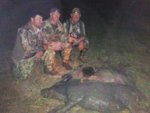
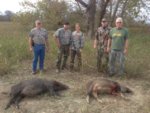
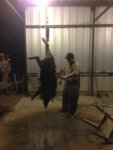
Group Tally: 0 hogs on night one, 1 hog on night two, 2 hogs on night three (see photos) and 1 hog the day after I left (last photo—140 lb. sow)
I went with a group of guys (and one gal) with whom I’ve hunted in the past—mostly prairie dogs—in AZ and WYO.
The guy who organized this hunt has been a guest there for many years and has a great relationship with the owner—who has deep roots in the region dating back to a time before the Texas Revolution.
We had a total of 8 hunters. The property is approximately 2200 acres. There are no high fences, so game comes and goes at will.
Almost all hunting for hogs is done at night—so having a cooperative moon/sky conditions a must. As mentioned, there was a total of 8 hunters—and we paired up each night and rotated areas every day. I hunted from deer stands for the first two nights. I saw three HUGE hogs the first night but blew the chance when I made contact between the window frame and my barrel as I was trying to adjust for a shot—and realized in my zeal for safety I’d forgotten to chamber a round after climbing up the ladder to the stand. That one hurt! They truly were monsters.
Second night—rotated stands and saw at least 30 deer. No pigs. The crew that manned our vacated stand from the night prior bagged a hog though—so the night was productive. Others were sighted but no opportunity to shoot.
During the day—after a truly generous breakfast and slaking one’s fill of java—most of us turned out to do some fine tuning on the rifle range—or go scouting. It was my first visit to the ranch, so I deferred the shooting for the afternoon and went scouting late morning of each day.
Found a lot of sign the first time I went out (second day at the ranch)—always near water. The area we scouted was generally east and north of the ranch house. After getting skunked on the second night (now day three) a group of four of us scouted the south/west boundaries of the ranch and found “hog heaven”. It was a seasonal creek that was once the actual course of the San Antonio river. In general it was bounded on each side by a defined levee system. The distance from the tops of the levees was probably a few hundred yards, but where the actual/recent flow was about 50-75 feet across and about 15-20 feet below the levee tops. As we found it—it was not flowing, but 90% mud (very deep/thick clay like) with some small areas of brackish standing water. It had flowed earlier in the year so some of these little ‘ponds’ still had fish in them—some were big enough to splash and thrash. This got my attention and certainly the same went for the hogs. Tracks went in/out of this area were fresh and numerous. The kicker about this spot was the HUGE hog wallow we found. You could actually make out the imprint of a hog that had been there recently (the night before) and it was BIG.
So, one of the other guys (Justin—former US Army marksman/sniper) and I decided to forego the deer stand for our next hunt and instead to go ‘tactical’. After scouting thoroughly, we made a plan for the evening hunt to go down to ground level right above that active wallow.
We had a lot of time to plan this out—so we brought a pop up blind down to one spot during the day and let it “settle”. We arrived back on site for the hunt about 45 minutes before sunset—and we ended up using every minute of it to finish setting up.
I was in the pop up blind with two clear lanes of fire—each about 20 to 30 degrees across and not more than 40 yards deep. That means I was about 20 yards from the near edge of the creek bottom. Justin initially set up in a “ghillie suit” sitting in the open against a tree—about 100 feet to my left and even closer to the wallow. We’d spiked the place with a lot of deer corn and had piles that were placed tactically—with hopes of getting them to stop right in the shooting lanes. We each had AR-15’s. He had a .45 pistol w/night sights as well. I had the room—so I brought my .375 Ruger African into the blind with me. Bog pod for support in my primary lane and a fold up set of shooting sticks for the other.
I should mention too that it was my turn to try out the Pulsar N550 digital night scope on my AR. This is a great setup—but in my case particularly—not easy to move around with. My AR is configured with a Stag model 6 upper in .223 with a heavy contour free floated 24” stainless barrel. The N550 is a BIG scope and combined I’d guess that rig weighed about 15 pounds with a full magazine. BTW, I’d zeroed it at the range (literally—100 feet outside the trailer where you stay while hunting) and had SUPREME confidence in it. Turns out—that using it during the day is MUCH easier than at night—esp. because of the dynamic nature of sitting in the dark with a full moon that was sometimes obscured by high clouds or low fog…
Justin and I had a good plan—a safe and well defined set of shooting lanes—and all the right gear. What we didn’t have initially was a way to communicate. His position was just over 100 feet to my left, slightly downhill and completely obscured in the dark. Luckily I had about 100 feet of light cord with me—so we decided to run a line between us—and use it to communicate with a hastily agreed upon set of signals. Three pulls = “I have hogs in sight/able to engage”. A reply of one pull = “I am not in a position to engage”, a reply of three pulls = “I am ready to engage”. The final signal of three pulls meant “I acknowledge—commence firing in THREE—TWO—ONE”. But of course—as I strung out the line from my blind I discovered we were about 120 feet apart. What to do? Luckily there is a vine growing wild right in the bottom land so we cobbled together about 25 feet of it and we were all set to go.
Sunset was at about 5:30 and moonrise wasn’t until over an hour later. Sunrise/sunset times vary gradually—not so the moon. The moon came up a full 50 minutes later on this night than the previous night—and when combined with our low position in relation to the horizon and the cover of trees made it REALLY DARK—and relatively quickly. We were in place and settling in just a few minutes after official sunset.
I spent the next hour + practicing with the night scope (eats batteries like crazy—so I limited power on cycles to just a few minutes). I also practice moving “whisper quiet” from one shooting lane to the next with a 15 pound rifle. I failed miserably on my first attempt—successfully knocking my tripod over. Luckily it was just twilight—so no damage done. I’m slowly tuning my senses to the quiet—to the sounds of the forest/hollow and going over various scenarios of engagement. Frontal, crossing, far bank, right side, etc. Now it’s a waiting game. Stay relaxed—but remain vigilant.
So, fast forward…It’s now just before 8 o’clock and I feel a huge tug (just one) on the blind. WTF? Did I snag/snare a deer? A small pig? Chupacabra?
No—it was Justin—a combat veteran who has kicked down doors in Afghanistan BTW—coming in. It was just too damned dark in his position. As he firmly stated: “This is a safety issue—mine!”
It was so dark that he literally put his AR down by his side—and with his back sitting against a tree he broke out his .45 and held it in the ready position. I failed to mention that our firing positions were on or right next to major game trails—and the only way in/out of the creek in this stretch of the holler was via these game trails. He was only 30-40 feet (max) from the wallow—and if a hog boogered out of there he would be completely exposed—at ground level—in almost complete darkness. I’m surprised he stayed as long as he did…
So, we settled in—him to my left at about 3-4 feet—outside the blind (all windows doors open since it’s so dark). We sit without much going on for about 30 minutes—moon is rising and the light is coming up. Next thing you know—we can hear hogs. My hearing ‘radar’ puts them in two places—10 o’clock at over 100 yards and back at my 4-5 o’clock across the creek or in the creek (50 yards max). In other words—they’ve executed an almost perfect pincer movement on us…
I can hear the right/aft group crunching—snorting, etc. but it’s not steady. They make noise—stop for a minute or two—make noise, etc. I sense them feeding toward us—through the bottom and coming in behind us on the same bearing. I hear one distinct “grunt”—then nothing. It had to have been inside of 20 yards.
It was quiet for almost 30 minutes—when the stillness was cracked with the “BOOM!” of a rifle. Someone in the deer stand (above/behind us about 60 yards) had taken a shot. Before anyone goes all 'safety' on me--we had VERY CLEAR Rules of Engagement--and they were facing 180 degrees away from us. They would not shoot aft of their 3-9 o'clock--nor could they realistically since there was only thick brush and timber behind them.
In any case...we listened for a follow up—but there was none. Out here the rule is to ‘pay the insurance’ EVERY time. More than one hunter has ‘stoned’ a pig where it stood, only to have it jump up and run off seconds (or in one case over ten minutes) later. There was no follow up shot—and so we began to wonder—did it run? Was it a coyote? (not likely to blow a pig hunt for a coyote). After a few minutes and no other shots we were ready to break cover—thinking the hunt had been at least temporarily busted. (Later that night we determined that we’d kicked up what turned out to be three pigs towards our companion hunters (again--about 60 yards behind us—facing toward the grass and deer feeder)—and they bagged one of them. I think it was those pigs I heard that were off to my right and close in).
Then, something came over me—a sense if you will—that we should stay put and just send a text message. Yes, the light from the phone would highlight us—but if you throw a jacket over your head—the illumination is knocked down 95%. So Justin typed away and hit “send”.
Good thing we didn’t move…2 minutes later—and not more than that--we heard pigs nearby.
This is where it got REAL interesting. In the next 40 minutes or so—we heard—then began to see hogs. How many? Hard to say—at least 4—likely many more. I was in the blind with the night vision scope. I could make out the corn—the piles especially—but when I boosted the view by engaging the IR illuminator—it revealed two things. One: the big pile of corn I’d been focused on was actually in Justin’s original shooting lane—and was completely obscured by dead branches about 5 feet thick. This was NOT apparent without IR illumination. The other issue is that the gain on the scope is VERY sensitive—and activation of the illuminator would cause huge “shadows” to be cast. In the IR illuminator mode, if you adjust to see what it illuminates best—you lose the fine detail and literally cast shadows that could be hiding what you’re after. So, lesson learned. I didn’t have the opportunity to use this in practice other than daytime or early in the evening—and never against a ‘live target’. This is a great piece of gear—and with just 10 minutes of real world simulation I’m sure I would have been MUCH less frustrated with my inability to find the hogs later on.
Earlier, when we had a lull—I’d asked Justin to scout through his rifle scope and asked him if he could make out the corn in the holler. The reply: “barely”. Knowing how good my binoculars are in low light (I’d just looked at the same thing—and the corn glowed like small embers) I had him take a look through them. Needless to say—I didn’t get them back that night!
We were now hearing a LOT of movement—and Justin spotted—one, two—no…THREE shoat sized hogs on the corn across the way. In fact—at one time, they were all lined up (I later learned). But I could NOT find them from where I was sitting. There were other hogs moving—neither of us could see them but one just sounded BIG—and then Justin saw it. It was trotting in and out of cover, across the bank—almost as if on patrol. Then it would come back down into the area near the wallow—and much on the corn. We could hear it when it stopped—but not see it.
Now the pitch of the potential battle is ramping up—as is my level of frustration. I can NOT see those far hogs on the corn. Tried the IR illuminator once—then again—and Justin (rightly so) softly barks—shut that thing off! Turns out—it puts out a small amount of visible red light and we think had alerted the hogs. Imagine each side—you see them, naked eye at times—and the dummy right next to you can’t find them with a high tech piece of night gear. Then there’s the “dummy” who feels like he should be riding the short bus—equipped with the high end gear—set up perfectly, etc. and CANNOT see the “they’re RIGHT THERE hogs”…
So—I take a DEEP breath and ask—where are they in relation to the tree? (there was an 8-10” wide and very tall tree in the center of the shooting lane). Justin slowly leaned into the blind—got on my sight line with the bino’s and in a hammered whisper announced: “Right behind the FU%*ING tree!”
Quick thinking on his part—we both (whisper quiet) agreed that I had to get out of the blind. He set his rifle across the line of sight on its bipod and dropped mine in at 90 degrees. Instant prone rest. So—we reset positions—hogs are moving—closer yet—and I STILL CAN’T SEE them! WTF?
Turns out—that in the prone position—there was a large deadfall about 10 feet ahead of us. Kneeling—you could spot them—prone—you couldn’t. Finally—a hog steps right out in the lane—on the near bank (maybe 25 yards) and starts to hammer on the corn. Needless to say our communication has become rather ‘charged’ by now—and I’m pretty pressurized. We’re not being whisper quiet—but not talking loud. As I break the prone position—I look up and FINALLY SEE this big old hog—right there! I’d told Justin earlier—in this environment—no prisoners. Too risky. Either the hog runs or charges so if I shoot once—I’m shooting five.
I don’t know how long it took—maybe a second…but I shouldered that beast—and as I did I could see that Justin was just ITCHING to drop this thing. Thank goodness he was a GREAT sportsman—and went to the ready and waited. That wait was all of a heartbeat—because I shouldered/sighted and squeezed in about that much time. One heartbeat…
It’s amazing how acute your senses and timing become when you’re dialed in for a few hours. I shoot and almost simultaneously I see/hear/feel Justin’s AR crack one off. Ironically—I’m left handed—and he’s on my left. We are no more than two feet from each other. In the next 3 seconds or so—I followed with three rounds—and Justin another—followed immediately by my fifth. Talk about a melee. Hot brass hitting him—hot brass hitting me--hogs start busting out—squealing and crashing in the brush. The NV scope flares during the muzzle flash—but apparently recovers quickly. It also obliterates the night vision in your aiming eye. I can honestly say all my shooting after the first round was instinctive—and probably not needed—but who knows. What I DO know is that hog went no more than a few steps after wheeling away on the impact of the first rounds. It turned about 90 degrees and dropped right down in the mud and began to slowly sink.
I was amazed though—as we both stand up to say “congrats” (quiet elation) we see yet ANOTHER hog walk into the shooting lane—if only for a second—then it busted out like it’s tail was on fire. I took another look through the NV scope for other hogs—and noticed that the one we dropped was still flopping an ear. I steadied the rifle and put one right behind the ear—and that finished it. We figured that there were indeed at least 5 and probably many more hogs in and around the scene of the engagement.
Rifles loaded and safe—but ready, we walked/plodded in to see what turned out to be a HUGE hog (by my standards anyway) and here’s the kicker—no “catcher’s mitt”, no “sack”…it was a SOW. The head was HUGE—and the rest of it was just plain big. Believe it or not—we heard at least one, if not two other hogs nearby—this is after standing up, talking in a normal voice (okay—maybe a “little bit” enthusiastic) and wearing my head lamp with bright xenon beams blazing away. There is a future for this place I reckon…
We did a post mortem and found 6 bullet strikes…not counting the ‘insurance’ shot. In addition to follow up shots—the rule here is to shoot in the head. A shoulder/lung shot hog WILL RUN—and in most places, very thick cover is only a few short paces away. There were three strikes in the head/spine area one toward the shoulder and two prominent “Texas heart shots”. I attribute those to my follow-up shots. The last shot likely went high since the pig dropped about the time I finished firing. Bottom line—we anchored it in place.
It took a 4 wheel drive ute and a chain to drag it out. The ranch manager (Louis) estimated that it tipped right at 300 pounds. My ethic has been to eat/use what I take in the field—but on his advice and respecting his opinion—we determined that this one best be moved far off and deposited for the coyotes and ravens to have at. Apparently, due to the age and size they’ve found that these large hogs are absolutely awful tasting.
Every hunt is unique—and this was no exception. Many ‘firsts’ for me—hunting from a stand, night hunting, baiting, etc. In retrospect, without the tactical action plan we made, there is no way you’d catch this hog unaware. Although the execution of the plan was somewhat flawed (on my part in particular) we had success. I learned a lot about an entirely different method of take—a lot about my ‘goods and others’ and most importantly—came away with GREAT memories—which to me are the trophy of a lifetime.
I can honestly say at the end of it all that this hog was “fairly chased and well taken”.
Group Tally: 0 hogs on night one, 1 hog on night two, 2 hogs on night three (see photos) and 1 hog the day after I left (last photo—140 lb. sow)